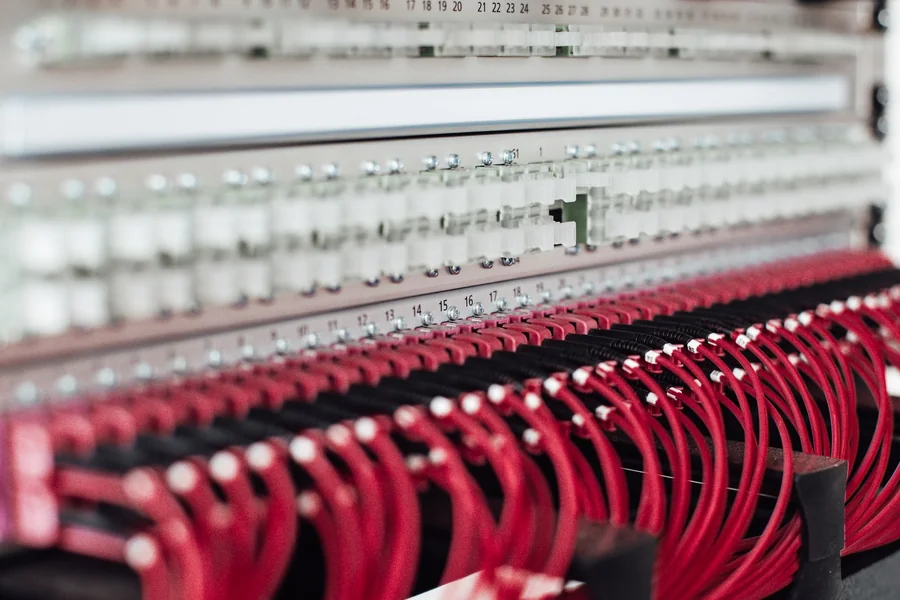
Introduction to 400G QSFP-DD Transceivers
The 400G QSFP-DD (Quad Small Form-Factor Pluggable Double Density) optical transceiver has become the dominant high-speed interface for modern data centers and telecommunications networks. As the successor to the 100G and 200G QSFP form factors, it supports data rates of 400 gigabits per second in a compact, hot-pluggable module. Its “Double Density” design refers to the increased number of electrical lanes—it uses an 8-lane electrical interface, with each lane operating at 50 Gbps using PAM4 (Pulse Amplitude Modulation, 4-level) signaling. This module is engineered to meet the explosive growth in bandwidth demand driven by cloud computing, AI clusters, 5G backhaul, and hyperscale data center interconnects.
Technical FAQs
What are the primary advantages of the QSFP-DD form factor?
The QSFP-DD form factor offers several critical advantages:
- High Port Density: Its compact size allows for up to 36 ports in a single 1U front panel, maximizing bandwidth per rack unit. This is a significant improvement over older, bulkier form factors.
- Backward Compatibility: The QSFP-DD port and module are designed to be mechanically and electrically backward compatible with QSFP modules. This allows a QSFP-DD port to accept a 40G or 100G QSFP transceiver (with an adapter), protecting existing infrastructure investments.
- Power Efficiency: Modern 400G QSFP-DD modules have improved power efficiency, with typical power consumption ranging from 10 to 14 watts, depending on the reach and technology. This is crucial for managing total data center power budgets.
- Scalability Roadmap: The form factor specification is designed to support future speeds of 800G and even 1.6T, providing a clear upgrade path for network operators.
What are the common types of 400G QSFP-DD modules and their applications?
Choosing the right module depends on transmission distance and existing fiber infrastructure. The main types are:
| Module Type | Standard | Max Reach | Fiber Type | Key Technology | Typical Application |
| 400G SR8 | 400GBASE-SR8 | 70m (OM3), 100m (OM4) | Multimode (MMF) | 8x50G PAM4, 850nm | Short-reach intra-data center, rack-to-rack |
| 400G DR4 | 400GBASE-DR4 | 500m | Single-Mode (SMF) | 4x100G PAM4, 1310nm | Mid-reach data center interconnects (DCI), campus links |
| 400G FR4 | 400GBASE-FR4 | 2km | Single-Mode (SMF) | 4x100G CWDM, 1310nm band | Longer DCI, metro edge connections |
| 400G LR4 | 400GBASE-LR4 | 10km | Single-Mode (SMF) | 4x100G CWDM, 1310nm band | Metro access and aggregation networks |
| 400G ER4 | 400GBASE-ER4 | 40km+ | Single-Mode (SMF) | 4x100G DWDM, coherent optics | Long-haul metro and regional DCI |
| 400G ZR/ZR+ | 400ZR, OpenZR+ | 80km – 120km+ | Single-Mode (SMF) | Coherent DWDM (16QAM/QPSK) | Coherent pluggables for long-haul DCI & telecom |
Are 400G QSFP-DD modules interoperable with other form factors?
Interoperability is a common concern. Key points include:
- Breakout Connectivity: Many 400G QSFP-DD modules support breakout functionality. For example, a 400G DR4 module can connect via an MPO-12 to 4x Duplex LC breakout cable to four separate 100G QSFP28 ports (using 100GBASE-DR transceivers). This allows flexible migration from 100G to 400G networks.
- Forward Error Correction (FEC): For PAM4-based links (like SR8, DR4, FR4), IEEE-standard Clause 91 RS-FEC (Reed-Solomon) is mandatory. Interoperability requires FEC settings to match on both ends of the link. Coherent modules (ZR) use different, more powerful FEC.
- Vendor Compatibility: While designed to meet multi-source agreement (MSA) standards, it is always recommended to verify vendor interoperability matrices or use modules that are coded and tested for compatibility with your specific switch brand (Cisco, Arista, Juniper, etc.).
Deployment and Selection FAQs
How do I choose between a PAM4-based module and a Coherent module?
This is a fundamental decision based on reach and fiber plant:
- Choose PAM4-based modules (SR8, DR4, FR4, LR4) for distances up to 10km over relatively simple fiber links. They are generally more cost-effective and have lower power consumption for these reaches. They are the workhorses for inside data center and short DCI applications.
- Choose Coherent modules (400ZR, ZR+) for distances from 80km to 120km+, or when you need to transmit over existing DWDM (Dense Wavelength Division Multiplexing) line systems. They are essential for long-haul DCI and are increasingly used in telecom transport networks. They offer superior performance in challenging conditions but at a higher cost and power budget.
What are the critical considerations for fiber cabling with 400G?
Fiber infrastructure must be validated:
- For SR8 (MMF): Ensure you use OM4 or OM5 grade multimode fiber. OM5, also known as “wideband multimode fiber,” is optimized for short-wavelength division multiplexing (SWDM) and provides better performance for high-speed links. Strictly adhere to the maximum reach specifications.
- For DR4/FR4/LR4 (SMF): Standard OS2 single-mode fiber is required. Pay close attention to connector cleanliness and insertion loss. The higher data rates are much less tolerant of dirty or poorly mated connectors. An inline loss budget of < 2.0 dB is typically recommended.
- MPO Cabling: For parallel optic modules (SR8, DR4), precise MPO/MTP cabling is critical. Ensure polarity (Method A, B, or C) is correctly designed and implemented end-to-end.
What are the best practices for troubleshooting a 400G link?
If a 400G link fails to come up, follow a systematic approach:
- Check Physical Layer: Inspect and clean both ends of the optical connectors using a certified fiber inspection scope and cleaning tools. This is the most common cause of failure.
- Verify Module Status: Use the switch’s CLI to check the Digital Diagnostics Monitoring (DDM) data—RX power, TX power, temperature, and voltage. Ensure received optical power (Rx Power) is within the module’s specified sensitivity range.
- Validate Configuration: Confirm that the port speed and FEC settings are correctly configured and match on both ends of the link. Auto-negotiation may not be supported on all 400G interfaces.
- Test with Known-Good Components: If possible, swap the transceiver and fiber cable with verified working units to isolate the faulty component (module, cable, or switch port).
Conclusion
400G QSFP-DD transceivers are complex but essential components for next-generation networks. Successful deployment hinges on understanding the trade-offs between different module types, ensuring fiber infrastructure readiness, and adhering to best practices for installation and troubleshooting. As the technology matures, prices continue to decline, making 400G the new benchmark for high-density aggregation and interconnect. Always consult the latest vendor documentation and MSA specifications for the most up-to-date information before finalizing your design.